Let’s start with a number that should make any business owner pause: 86% of customers will stop doing business with a company after just two bad service experiences. That’s not a rounding error, that’s most of your customer base walking out the door because support failed them.
And yet, in my experience working with growing US businesses, customer support is almost always the last thing that gets proper investment. Teams are stretched thin, tickets pile up, response times slip, and slowly, quietly, customers stop coming back.
This is exactly why outsourced customer support has shifted from a cost-cutting tactic to a genuine strategic move. When done right, it doesn’t just keep the lights on, it becomes one of the most reliable competitive advantages a business can build.
In this guide, we’ll cover what outsourced customer support actually means today (it’s changed a lot), which model makes sense for your business, how to transition without losing quality, and the real risks nobody talks about. No fluff, no vague frameworks , just the practical stuff.
What Is Outsourced Customer Support?
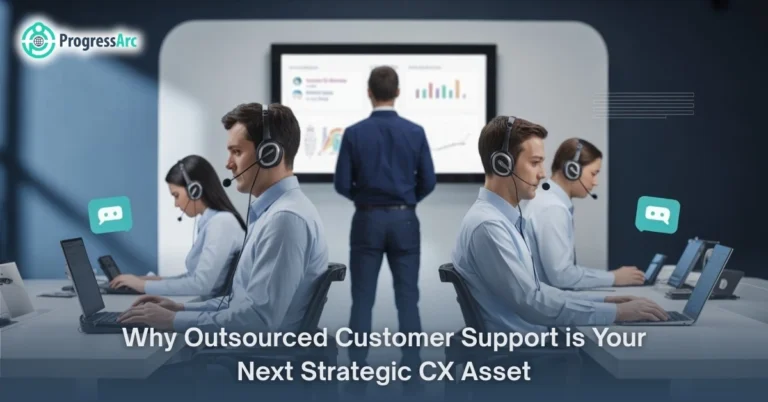
Outsourced customer support means partnering with a third-party provider to handle some or all of your customer service , including phone, email, chat, and social media. It lets businesses scale CX quickly, reduce overhead, and tap into specialized talent without building an in-house team from scratch. Today’s providers work as true brand extensions, not just answering services.
What Customer Support Outsourcing Actually Looks Like in 2026

The term “outsourced call center” used to conjure images of script-reading agents in distant time zones giving canned responses. That’s a 2005 picture. The reality in 2025 is completely different.
Customer support outsourcing today means working with an external customer support team or specialized global customer service provider that functions as a genuine extension of your brand. These teams are trained on your product, they know your tone, and they work within your systems , your CRM, your ticketing tools, your escalation workflows.
What’s changed most is scope. Modern outsourcing can cover:
• Tier-1 support , FAQs, order tracking, basic troubleshooting
• Tier-2 and technical support, product-specific issues, integration help
• Billing and account management queries
• Retention and churn-prevention conversations
• Omnichannel support across phone, email, live chat, SMS, and social media
• AI-augmented support, human agents backed by AI tools for faster resolution
According to the Deloitte Global Outsourcing Survey 2024, 70% of companies cite cost reduction as a primary outsourcing driver, but 40% now rank quality and capability access equally important. That shift matters. It signals that outsourcing has matured from a back-office efficiency play into a front-line CX strategy.
The Real Strategic Case for Outsourcing Customer Service
Here’s where I want to push back on a common misconception: outsourcing isn’t giving up control of your customer experience. Done right, it’s gaining more control because you’re working with people who specialize in CX full-time, rather than asking product engineers or sales reps to cover support tickets on the side.
The businesses that benefit most from outsourcing share a few common traits. They’re growing faster than they can hire. They’re entering new time zones without local staff. Or they’re dealing with seasonal volume spikes that make headcount planning impossible.
Here’s what consistently drives companies toward a third-party customer support model:
• Speed to scale Ramp a trained support team in weeks, not quarters. No job postings, no lengthy onboarding cycles.
• Genuine cost savings Eliminate recruiting fees, benefits, office space, and training infrastructure. The per-hour savings can be significant depending on the model you choose.
• Specialized expertise The best outsourcing partners have agents who’ve handled thousands of tickets in your industry. That depth is hard to build internally from scratch.
• 24/7 coverage without burnout Cover nights and weekends across global time zones without destroying your core team’s work-life balance.
• Internal focus Free your product and engineering teams to build, instead of triaging support queues.At ProgressArc, we’ve worked with SaaS companies and tech businesses that pair outsourced customer service with back-office support like bookkeeping services and accounts receivable management. The combined impact on operational efficiency is almost always greater than either piece alone.
Decoding the Core Models: Onshore, Nearshore, and Offshore Customer Support
This is where most business owners get confused , and where bad decisions get made. The model you choose will determine your cost structure, your coverage hours, your communication quality, and your risk profile. So let’s be direct about what each option actually means.
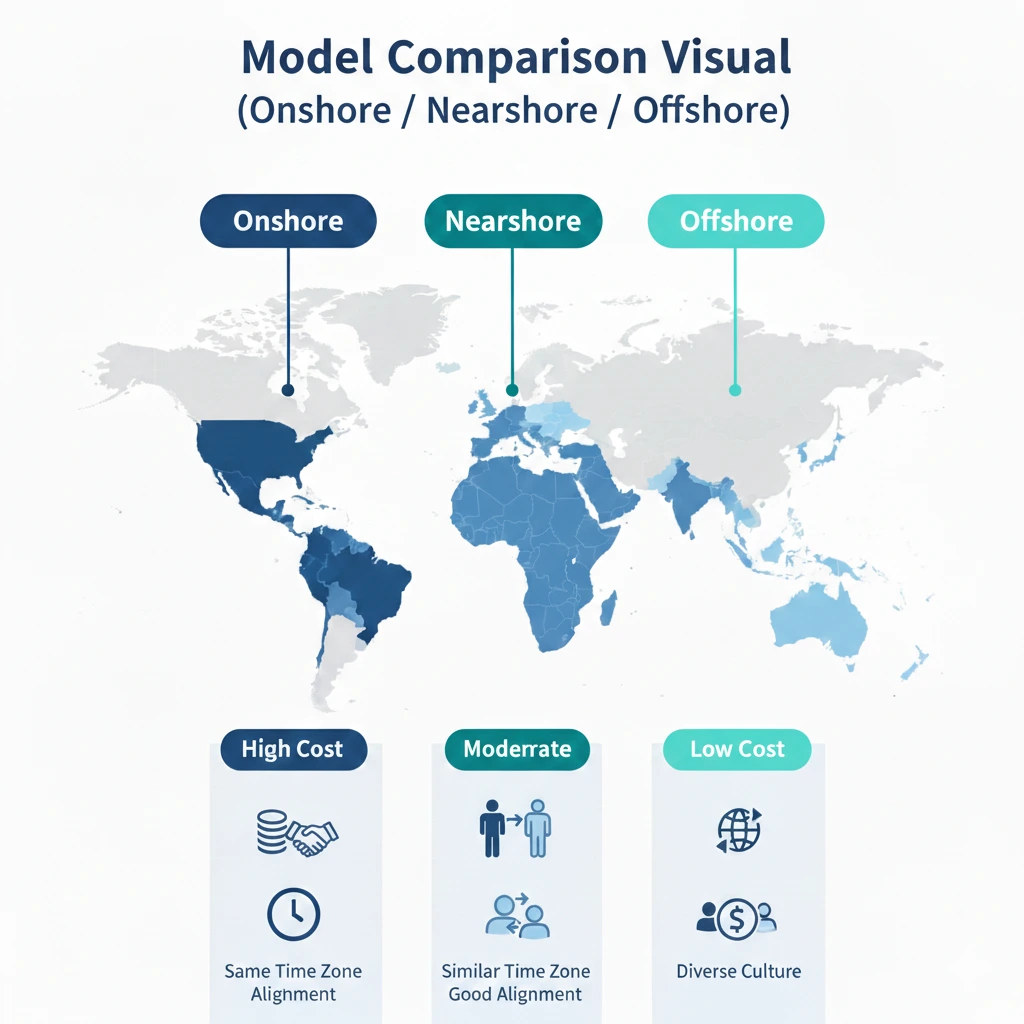
At a Glance: Model Comparison
| Model | Location | Cost Range | Best For |
| Onshore | USA | $25–$45/hr | Compliance-sensitive, enterprise |
| Nearshore | Mexico, Colombia | $15–$25/hr | Balanced cost + alignment |
| Offshore | Philippines, India | $8–$15/hr | High-volume, transactional |
Onshore Customer Support , Built for Complexity
Onshore means your outsourced team is based inside the United States. Same time zones, no language barriers, strong compliance alignment.
Best for: Industries with strict regulatory requirements , healthcare, legal, financial services , or premium brands where every customer interaction carries significant relationship value.
The trade-off is cost. Onshore is the most expensive model, but for certain use cases, that premium is completely justified. A compliance failure in a healthcare support interaction, for example, can cost far more than the savings from going offshore.
Nearshore Customer Service Outsourcing , The Practical Sweet Spot
Nearshore customer service outsourcing means partnering with teams in neighboring countries , Mexico, Colombia, Costa Rica, and Canada are the most popular destinations for US businesses.
What makes nearshore attractive isn’t just cost. It’s the combination of overlapping business hours, strong English proficiency, and genuine US cultural familiarity. Many nearshore agents grew up watching American media, understand American consumer expectations, and can match your brand’s conversational tone in ways that purely offshore teams sometimes can’t.Cost savings typically run 30–50% vs. onshore. For most mid-market US businesses, nearshore is the right default unless there’s a specific reason to go onshore or offshore.
Offshore Customer Support , Maximum Efficiency at Scale
Offshore customer support connects you with remote customer support agents in countries like the Philippines, India, or Eastern Europe , where costs are lowest and agent availability is highest.
The Philippines has become the dominant offshore CX hub for US companies for good reason. English proficiency is high (it’s a co-official language), the culture has strong US influence, and the BPO infrastructure is mature and well-established.
Best for: High-volume, transactional support , order status, basic troubleshooting, FAQ responses , where the queries are repeatable and the cost savings at scale are significant.
The challenge with offshore is real: time zone gaps can create response delays, and if agents aren’t carefully trained on your brand voice, interactions can feel generic. The solution isn’t to avoid offshore , it’s to vet providers rigorously and invest in training.
The Rise of Hybrid and Specialized Outsourcing Models
Most businesses today don’t pick just one model and stick with it. They build layered, hybrid structures that optimize for both cost and quality across different support tiers.
A common setup that works well for mid-size US companies looks like this:
• Onshore team handles enterprise accounts and compliance-sensitive escalations
• Nearshore team manages general inquiries and second-tier technical support during US business hours
• Offshore team covers overnight volume, weekends, and high-frequency tier-1 queries
This structure lets you control cost on volume while protecting quality where it matters most. It also builds in redundancy , if one tier is stretched, another can absorb overflow.
Beyond geography, specialized models have matured significantly:
Industry-specific BPOs , Providers who specialize in SaaS, eCommerce, fintech, or healthcare bring pre-built knowledge bases, trained agents, and faster onboarding timelines.
• AI-augmented teams , Human agents backed by AI suggestion tools, real-time sentiment analysis, and automated ticket routing. The result is faster resolution times and more consistent responses.
• Dedicated vs. shared agent models , Dedicated agents work exclusively for your brand and develop genuine product expertise. Shared agents work across multiple clients , better for lower volumes, but depth of knowledge is shallower.
If your business includes software products, pairing outsourced support with offshore software development or QA outsourcing creates an integrated external team that covers both the product and the customer experience layer , without the overhead of managing multiple internal departments.
A Practical Framework for Choosing Your Outsourcing Model
Stop reading generic advice about “aligning outsourcing with business goals.” Here’s a four-step framework that actually helps you make the decision:
Step 1: Define Your Primary Driver
Are you outsourcing to cut costs, to cover hours you can’t staff, to access expertise you don’t have, or to scale faster than internal hiring allows? These lead to meaningfully different model choices.
If cost is the primary driver: Start with offshore or nearshore. Budget aggressively for training quality.
If quality is the primary driver: Start onshore or nearshore. Don’t let per-hour rate comparisons be your deciding factor.
If coverage hours are the primary driver: Offshore is often the most efficient solution for overnight and weekend volume.
Step 2: Be Honest About Your Support Complexity
Low-complexity support (FAQs, order tracking, basic troubleshooting) can go offshore or nearshore without significant risk. Medium-complexity support , billing disputes, technical troubleshooting, retention conversations , should stay nearshore or with a dedicated offshore team that gets deep product training.
High-complexity or compliance-sensitive support (HIPAA, financial regulations, legal queries) should stay onshore unless you have very strong compliance expertise in your nearshore provider.
Step 3: Think Honestly About Scalability
If you’re a startup expecting 3x growth in the next 18 months, or a seasonal business with volume swings of 200–300%, flexibility in your contract structure matters enormously. Look for providers offering scalable seat models and quarterly contract reviews rather than rigid 12–24 month commitments.
Step 4: Don’t Optimize Only for Cost
This is the mistake I see most often. A company chooses the cheapest provider, gets mediocre CSAT scores for 6 months, then spends more money switching providers than they saved. The better approach: define your target KPIs first , CSAT, FCR, AHT, escalation rate , and find a provider who can hit them within your budget.
Key metrics to track once you go live:
• FCR (First Contact Resolution) What percentage of issues are resolved in a single interaction? Industry average is around 70–75%. Anything below 65% signals a training problem.
• CSAT (Customer Satisfaction Score) Direct customer ratings on individual interactions. Aim for 85%+.
• AHT (Average Handle Time) Longer isn’t always worse , it depends on your support complexity.
• NPS (Net Promoter Score) Tracks overall brand sentiment, not just individual interactions.
• Escalation Rate How often do tier-1 agents need to kick issues up? High rates signal knowledge gaps.
How to Transition to an External Customer Support Team Without Losing Quality
The transition is where most outsourcing arrangements succeed or fail , and almost every failure is preventable. Here’s what actually works:
1. Document everything before you hand anything over. SOPs, tone guides, escalation trees, canned responses, FAQ documents , if it lives in someone’s head, get it on paper first. Your external team can only be as good as the knowledge you give them.
2. Start with one channel or one tier. Don’t hand over all support on day one. Transition email first, then chat, then phone. Or transition tier-1 only and keep escalations internal until the team is established.
3. Run a shadow period. Have your external team shadow your internal agents for 2–4 weeks. Then flip it , your internal team reviews their work in real time before they go live solo.
4. Define SLAs in the contract, not as a verbal agreement. Response times, resolution targets, CSAT minimums, escalation procedures , all of it needs to be contractually defined with consequences for missing targets.
5. Build a real communication rhythm. Weekly syncs, shared dashboards, a single internal point of contact. The external team needs to feel like your team , that only happens with consistent, structured communication.
One thing worth noting: most customers won’t notice the transition if your external team is properly trained and brand-aligned. And that’s exactly the standard you should hold your provider to.
Outsourced Customer Support for SaaS and Tech Businesses
SaaS businesses face a specific outsourcing challenge that’s worth addressing directly: your customers are often highly technical, they’ve already tried to self-serve before reaching out, and they have low tolerance for generic responses.
The right outsourcing partner for a SaaS company isn’t just a call center, it’s a team that’s been trained deeply on your product, can navigate your documentation, understands your integrations, and knows when to escalate vs. when to resolve.
Many SaaS companies we work with also pair customer support outsourcing with managed billing support, because billing questions are one of the top three drivers of support volume in SaaS, and unresolved billing issues are a direct path to churn. When a trained external team resolves billing friction quickly, the downstream effect on retention is measurable.
If you want a deeper look at why this model works specifically for growing businesses, our piece on why outsourced customer support works goes further into real-world results.
The Risks Nobody Talks About, And How to Actually Manage Them
Most outsourcing articles gloss over the risks or mention them in passing. Let’s be direct.
Risk 1: Loss of Brand Voice
This is the most common complaint, and it’s almost entirely preventable. The cause is usually a thin onboarding process , a brief orientation call and a product overview PDF. That’s not enough.
Solution: Build a detailed brand voice guide before onboarding starts. Include tone examples (formal vs. casual, assertive vs. empathetic), phrases to use and avoid, sample responses for common scenarios, and real examples of interactions that represent your brand well. Treat brand training as an ongoing process, not a one-time event.
Risk 2: Data Security and Compliance
When customer data leaves your internal systems and flows through a third-party provider, your exposure increases. This is a real risk , not a hypothetical one.
Solution: Vet providers for SOC 2 Type II certification, ISO 27001, and GDPR/CCPA compliance. Include detailed data handling clauses in your contract covering storage, access controls, breach notification timelines, and audit rights. Don’t treat this as a checkbox , ask providers to walk you through their actual security protocols.
Risk 3: High Agent Turnover at the Provider
The BPO industry has notoriously high agent attrition , the industry average sits around 35% annually. High turnover means you’re constantly re-training new agents and losing the product knowledge built over time.
Solution: Ask every provider you evaluate for their specific attrition rate. The best providers maintain rates well below the industry average through better compensation, career development programs, and agent culture. Low turnover is a leading indicator of a well-run outsourcing partner.
Risk 4: Cultural Misalignment
For US audiences, cultural nuance matters. The ability to read tone, understand idioms, and match the emotional register of a frustrated customer isn’t just a language skill, it’s cultural fluency.
Solution: For customer-facing roles, prioritize nearshore providers with documented US cultural training, or offshore providers in markets with strong US cultural familiarity (like the Philippines). During vendor evaluation, run live test interactions and score them against your brand standards before signing.
Conclusion: Make Outsourcing a CX Strategy, Not a Cost Exercise
Here’s the honest bottom line: outsourced customer support works when you treat it as a strategic investment, and it fails when you treat it as a way to cut corners.
The businesses that consistently see strong results , better CSAT scores, lower support costs, faster resolution times , share one common trait. They put serious work into the transition. They document their processes, they invest in training, they establish clear SLAs, and they treat their external team like an extension of their brand rather than a vendor at arm’s length.
The model you choose matters less than how well you execute it. A well-run offshore team will outperform a poorly managed onshore team every single time.
If you’re ready to explore what this could look like for your business, start with our customer services page to see how ProgressArc approaches CX outsourcing for growing US companies.And if you’re thinking about outsourcing as part of a broader operational strategy, our posts on offshore recurring billing for startups and QA outsourcing are worth reading alongside this one.
Frequently Asked Questions About Outsourced Customer Support
These questions come up consistently from businesses evaluating their first outsourcing partnership. The answers are written to be direct and practical.
Outsourced customer support means partnering with a third-party provider to manage your customer service operations , including phone, live chat, email, and social support. Instead of hiring and managing an in-house team, you work with a specialized external provider who handles customer interactions on your behalf.
Costs depend on the model you choose. Offshore agents typically range from $8 to $15 per hour, nearshore agents from $15 to $25 per hour, and onshore US-based agents from $25 to $45 per hour. Many providers also offer per-contact or outcome-based pricing, which can work well for lower-volume businesses.
Absolutely. In fact, small businesses often see the biggest gains. You get access to trained CX agents, proper infrastructure, and 24/7 coverage without hiring a full in-house team. It lets you compete at an enterprise level without enterprise overhead.
Offshore means your support team is based in geographically distant countries like the Philippines or India , typically the most affordable option. Nearshore means your team is in a neighboring country like Mexico or Colombia, offering closer time zones, stronger cultural alignment, and English proficiency at a mid-range price point.
The key is treating your external team like an internal one. Set clear SLAs upfront, invest in thorough onboarding, share your brand voice guide, and track KPIs like CSAT, FCR, and AHT on shared dashboards. Schedule regular performance reviews and treat issues as collaboration opportunities , not vendor complaints
Yes, many BPOs specialize in technical support for SaaS, fintech, and hardware companies. The key is choosing a provider with relevant industry experience and running a dedicated product training program before they go live. Escalation paths and knowledge base access are critical here.
Modern outsourced call center services can handle phone, live chat, email, social media (Twitter/X, Facebook, Instagram), SMS, and in-app messaging. The best providers offer true omnichannel support so your customers get consistent service regardless of how they reach out.