In 2021, we observed a technology boom caused by the pandemic that was boosted by a $2 trillion stimulus. This led to a whirlwind of funding, exits, and values that had never been seen before. We entered an era of growth at all costs, with abrupt cost reductions, tools, and technology consolidation. This shift in efficiency, driven by investments in strategies, tools, and technology, is finally addressing the customer experience challenges throughout the entire lifecycle. Only in the USA are businesses losing $1.4 to 1.6 trillion due to bad customer experience. The unhappy customers say nothing and simply leave. They do not escalate. They do not complain. They do not give your team a second chance. They disappear, and they take their lifetime revenue with them.
These are the real consequences of common customer service problems left unresolved and ignored for years. Businesses that want long-term customer relationships and growth in revenue are now investing in AI tools that improve customer experience.
In this blog, we will analyze the specific, documented challenges in customer support teams that are costing businesses revenue and accelerating churn. We will also discuss the actionable strategies that need to not only survive in a chaotic business world, but also to thrive in a world that values efficient growth.
Understanding the True Scale of the Customer Support Crisis
The Numbers That Define the Problem
Before examining individual pain points, it’s important to comprehend the overall cost of subpar customer service. These forecasts are not conjectural. The financial and operational realities of customer support failure in 2026 are defined by these industry-validated data, which also illustrate why companies can no longer treat support as a back-office activity.
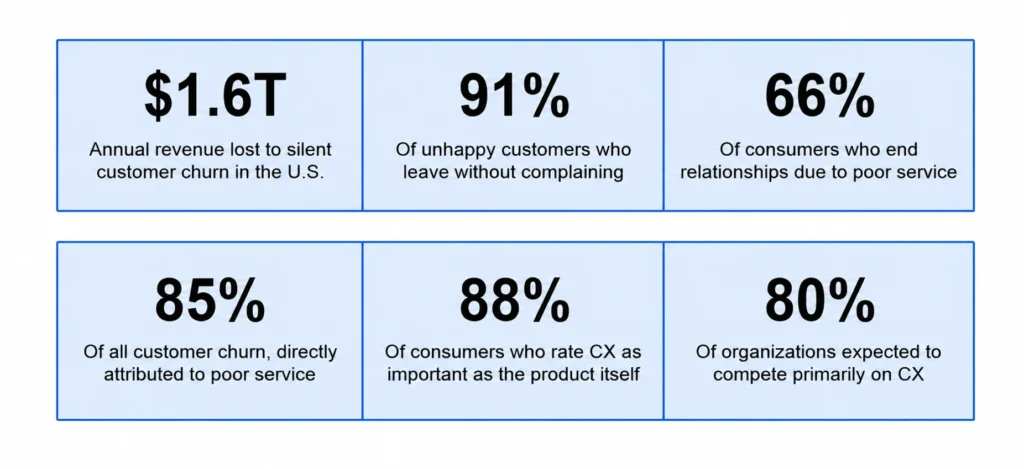
These figures reframe everything. For decades, customer support was treated as a cost center. The data presents an entirely different picture: customer experience is now the key difference in the market, and any company that fails to provide it faces grave risks.
| The Silent Leaver Problem 91% of disgruntled consumers just walk away without complaining. Because it produces no warning indication, this type of churn is the most hazardous. Most companies simply monitor the outspoken 9% of customers who express unhappiness. Until it appears in revenue records, the remaining 91% is unseen. The relationship had already ended by then. |
Customer Experience Is Now the Product
Nowadays, 88% of consumers think that the customer experience is just as important as the product. An average product given through an amazing support experience is more profitable than a technically superior product delivered through a subpar one.
Eighty percent of businesses emphasize client retention and growth. The Skyrocketers take a proactive approach to optimizing revenue potential and putting growth ideas into action. The only purpose is to enhance the quality of the customer service.
The Silent Leaver and the Churn You Cannot See
The Problem in Detail
The person sending escalated emails is not your most hazardous client. The consumer who had a bad experience, thought it wasn’t worth complaining, and discreetly transferred their account to a rival company without uttering a word is the most harmful. The distinguishing characteristic of contemporary customer service team problems is that the failures that are invisible are invariably more costly than those that are visible.
It’s clear from research that 91% of disgruntled consumers just walk away instead of complaining. Additionally, 66% of customers stop doing business with a company because of subpar customer service. Poor customer service is directly responsible for 85% of all customer attrition, not product failure, pricing, or competition. This has a direct financial impact. assistance.
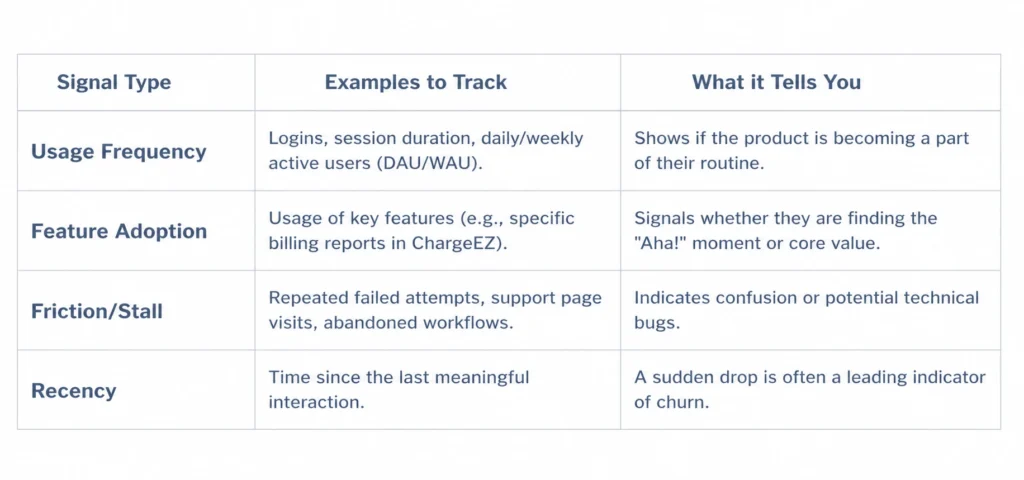
| THE PROBLEM91% of unhappy customers leave abruptly without warning. Standard ways of getting feedback from support only get the noisy few. Most churn isn’t noticeable until it shows up in revenue data, which is too late to fix. | THE SOLUTIONImplement proactive customer health surveillance. To identify at-risk accounts before they reach the point of silent departure, monitor engagement signals such as login frequency, feature usage, ticket attitude, and response rates. |
Why Reactive Support Models Cannot Catch Silent Leavers
Reactive frameworks are the foundation of traditional support operations: a consumer contacts support, the team fixes the problem, and the ticket is closed. Due to its structural blind spot, this model only records clients who voluntarily contact it. A ticket is never issued for silent departures. They decide to leave in privacy after encountering conflict or disappointment. The relationship has already ended by the time this decision appears in your data.
The required shift is from reactive to proactive customer support. A strategic approach to customer management is proactive customer health monitoring, which involves anticipating a client’s demands, friction areas, or potential turnover before they need to seek assistance. ProgessArc AI Customer support software uses data to spot patterns in behavior and take early action rather than waiting for a reactive ticket or complaint.
How to Reduce Silent Churn: Practical Steps
| Step 1: Implement customer health scoringBased on engagement signals such as product login frequency, feature adoption depth, ticket history, and communication response rates, give each account a health score. Your early warning mechanism for possible quiet churn is a falling health score. |
| Step 2: Conduct micro-surveys following interactions Send a quick, low-friction satisfaction signal request following each support interaction. A single inquiry, such as “Did we resolve your issue today?” generates a data layer that reveals discontent before leaving. |
| Step 3: Flag tickets closed without resolution confirmationAn automated follow-up should be triggered for any ticket deemed resolved without client confirmation. Closed-on-agent-side does not equate to resolved-on-customer-side, and quiet departures arise precisely in this gap. |
| Step 4: Divide the churn analysis based on the history of support interactionsThe support interaction history of each churned account in the ninety days before departure should be examined. The support failures with the highest churn correlation are identified by patterns. |
| Step 5: Create a win-back procedure for accounts that are at risk in step five.Instead of using an automatic email, a professional customer success specialist should initiate proactive outreach when health scores fall below a predetermined threshold. When human outreach is done at the correct time, conversion rates are far greater than those of any automated sequence.. |
| How ProgressArc.io Solves This ProgressArc.io’s customer support software operates proactive support models, not just reactive ticket resolution. By combining AI-powered customer health monitoring with human-led outreach protocols, ProgressArc AI customer support chatbot helps businesses identify at-risk accounts before they become silent leavers. Agents work with your CRM and product data to flag declining engagement signals and intervene with the right message at the right time. Learn more at progressarc.io. |
Section 3: Inconsistent Answers That Destroy Customer Trust
The Problem
Every client connection is built on trust. And nothing undermines trust more quickly than getting conflicting responses regarding the same problem from various agents. Across all industries and team sizes, inconsistent responses are among the most detrimental and enduring high customer service issues that firms encounter.
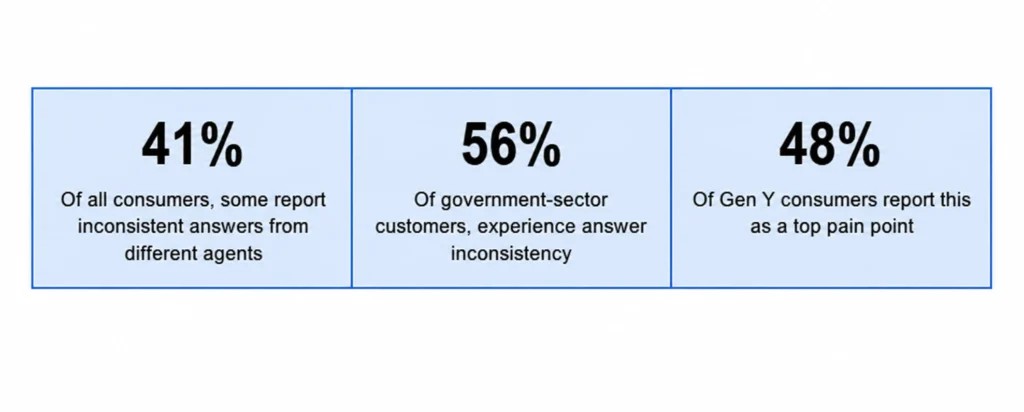
41% of customers claim that different support representatives have given them conflicting responses. There is a significant psychological impact when a customer is told one thing on Monday and something completely different on Thursday. The client does not draw the conclusion that a single agent made a mistake. They come to the conclusion that the business is incompetent and that whatever response they get could not be trustworthy.
In certain industries, this issue is very serious. 56% of clients in the public sector receive inconsistent responses. The percentage rises to 48% among Gen Y consumers, who make up the majority of present and potential clientele. A systemic, pervasive failing that affects all businesses and demographics is inconsistency.
The Root Cause: Knowledge Without Structure
Inconsistent answers are a knowledge management problem, not a training problem. When agents resolve tickets based on personal memory, informal knowledge, or outdated documentation, inconsistency becomes inevitable.
ProgressArc AI Chatbot can help with this. Progressarc customer support software consolidates knowledge into a single, versioned, constantly current source of truth rather than depending on dispersed or out-of-date information.
Agents can easily retrieve responses straight from this centralized system rather than from memory when using organized processes. The outcome? Quicker answers, reliable assistance, and no guesswork.
How to Fix Answer Inconsistency in Your Support Team
| Step 1: Build and enforce a single source of truthOne centralized, versioned knowledge base must contain all policies, resolution procedures, and product details. With ProgressArc AI Chatbot, this becomes automated. The system ensures that every response is based on the same verified information rather than personal recollection by combining all support knowledge into a single, constantly updated source of truth. |
| Step 2: Implement mandatory knowledge base citation in ticketsProgressArc’s AI guarantees that each response is produced straight from the knowledge base rather than depending on agents to manually cite sources. In addition to ensuring consistent, accurate, and traceable responses throughout all encounters, this establishes inherent accountability. |
| Step 3: Run weekly consistency audits on high-volume topicsProgressArc AI software continuously examines conversations to find inconsistent responses, as opposed to manual weekly audits. It allows teams to make improvements in real time rather than after the fact, reveals gaps, and flags out-of-date information. |
| Step 4: Standardize responses with AI-driven templatesFor frequently asked questions, ProgressArc’s customer support solution automatically produces consistent, context-aware answers. Regardless of the agent or channel, these AI-driven templates guarantee that every consumer receives the same trustworthy information while maintaining accuracy and enabling customisation. |
| Step 5: Establish a knowledge management ownerProgressArc’s AI software functions as an intelligent knowledge manager, constantly updating, organizing, and optimizing material depending on fresh data, queries, and interactions, as opposed to designating a single owner. This ensures that your information base is always current, pertinent, and trustworthy. |
| How ProgressArc.io Solves ThisThe ProgressArc customer support system integrates your knowledge base, CRM, and product documentation into a single agent workspace. When an agent creates a ticket, your unified knowledge source instantly retrieves the customer’s entire history and the most recent approved responses. Agents cannot give different answers when using the same real-time source. Visit progressarc.io to learn about the structure of the platform. |
Section 4:The Knowledge Gap That Leaves Customers Without Answers
The Problem
When a customer service representative claims they don’t know the answer, can’t locate the information, or provides a response that is obviously ambiguous or inaccurate, it can do more harm than nearly anything else. Of all the difficulties faced by customer service teams, the knowledge gap is the one that customers experience most immediately.
34% of consumers report that service representatives are unable to respond to their questions. This increases to 40% among Gen Y consumers, who are the most research-focused, digitally native, and likely to have tried self-service before contacting you.
| The Self-Service Failure Chain81% of customers attempt to resolve issues on their own before contacting a live representative. However, 31% find it difficult to locate solutions on business websites. These clients are already irritated, have already spent time, and are cautious when they approach a human agent. The conversation becomes not only unproductive but actively detrimental to the relationship if the agent likewise doesn’t know the answer, a situation that 34% of consumers report. |
The Two Dimensions of the Knowledge Gap
Dimension 1 — Missing Documentation: The answer does not exist in written form anywhere in the organization. This happens when products evolve faster than documentation, when tribal knowledge lives only in the heads of senior agents, and when knowledge base maintenance is not resourced or prioritized.
Dimension 2 — Inaccessible Documentation: The answer exists, but agents cannot find it efficiently during a live interaction. They search multiple systems, struggle with inadequate search functionality, or lack training to navigate under time pressure. Both dimensions require targeted solutions — accurate diagnosis is the prerequisite to effective remedy.
How to Close the Knowledge Gap
| Step 1: Conduct a knowledge audit against your ticket taxonomyCategorize your ticket types and systematically verify whether each category has clear, current, findable documentation. Every category with a documentation gap is a knowledge gap risk that will surface in agent performance. |
| Step 2: Implement AI-powered knowledge surfacingModern AI customer support software can analyze ticket content in real time and automatically surface relevant knowledge base articles, past resolutions, and product documentation — without the agent needing to search manually. This is one of the most impactful applications of customer support automation software available today. |
| Step 3: Build an escalation path for genuine knowledge gapsWhen an agent cannot answer, there must be a clear, fast escalation path to someone who can — with a defined response time commitment. The worst outcome is an agent who stalls or guesses because the escalation path is unclear. |
| Step 4: Create a knowledge gap logging disciplineEvery ticket where an agent could not find an answer should be logged as a knowledge gap incident. Weekly review of these logs builds a prioritized documentation backlog that steadily reduces the gap over time. |
| Step 5: Invest in self-service qualitySince 81% of customers attempt self-service first and 31% fail to find answers, the customer-facing knowledge base is as important as the agent-facing one. A strong self-service experience deflects tickets and reduces the volume reaching human agents. |
| How ProgressArc.io Solves This When a ticket opens, ProgressArc.io leverages its AI support assistant to display pertinent context, product details, and resolution history right in the agent interface. The platform provides the answers, so agents don’t have to look for them. This method systematically lowers the 34% knowledge gap rate your team may currently encounter when combined with organised knowledge management procedures. Visit progressarc.io to learn how. |
Section 5: The 24/7 Availability Gap and the Customer Support Team Overwhelmed by Demand
The Problem in Detail
The expectations of customers regarding the availability of help have permanently changed. The idea that support is available five days a week, during business hours, is no longer an acceptable service standard. In fact, many customer support teams are overburdened by demand and unable to scale due to the operational reality of meeting modern expectations.
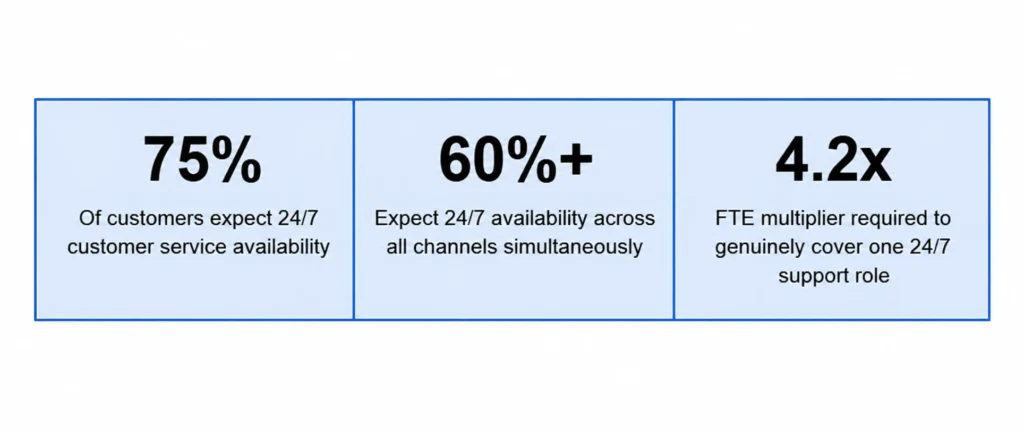
Nowadays, 75% of consumers need round-the-clock assistance. Over 60% of consumers desire this availability across all platforms, including chat, social media, in-app messaging, phone calls, and emails. It is perceived as a deficiency rather than a limitation when these expectations are not met.
It takes about 4.2 full-time equivalent workers to provide true round-the-clock human support coverage for a single support function, taking into consideration shift overlaps, days off, sick leave, training time, and turnover coverage. For companies smaller than enterprises, this cost structure is frequently unaffordable.
The Cost Reality of 24/7 Support
The average monthly cost of outsourced customer service services is between $2,600 and $3,400 per representative. It can cost more than $170,000 up front to build an internal 24/7 support capability before a single ticket is resolved. Genuine round-the-clock human coverage is financially unfeasible for the majority of expanding enterprises, despite the fact that 75% of clients need it. A structural solution is needed to close this gap.
| The Omnichannel DimensionThere is more to the availability problem than just hours. It has to do with channels. Consumers anticipate that when they initiate a live chat conversation at 11 p.m., the context of that interaction will be accessible when they follow up via email the following morning. The skill that turns 24/7 availability from a promise into a practical reality is omnichannel assistance, where conversation history and customer context accompany the customer across every touchpoint. |
How to Build a AI for Scalable Customer Services
| Step 1: Deploy a chatbot for your customer service team during off-hours AI customer support automation can handle FAQ-level queries, order status requests, password resets, and other high-volume, low-complexity issues 24/7 at a fraction of the cost of human coverage. The AI handles the volume; human agents handle the complexity. This is the most effective scalable customer support solution for businesses that need instant customer support without proportional headcount cost. |
| Step 2: Implement asynchronous support channe is Not every interaction requires a real-time response. Email and in-app messaging support with clearly communicated response time commitments significantly reduces real-time pressure on your team while still meeting customer expectations for availability. |
| Step 3: Partner with an outsourced support provider for off-hours coverage Outsourcing off-hours and weekend support delivers genuine 24/7 coverage without the 4.2x FTE overhead of building it internally. The key is selecting a partner whose quality standards and brand voice alignment meet your requirements. |
| Step 4: Build a robust self-service layer 60% of customers prefer self-service tools for simple tasks. A well-structured knowledge base, interactive FAQ, and community forum can resolve a significant share of off-hours queries without any human involvement — reducing both costs and customer frustration. |
| Step 5: Unify conversation history across all channe is Every customer touchpoint must feed into a single conversation record accessible to any agent on any channel. Without this, 24/7 availability becomes 24/7 repetition for the customer — one of the most universally cited customer pain points. |
| How ProgressArc.io Solves This ProgressArc.io provides 24/7 multichannel customer support outsourcing across email, live chat, phone, and in-app messaging. By combining AI-powered automation for Tier 1 queries with trained human agents for complex interactions — available across all time zones — ProgressArc.io delivers the full 24/7 availability that 75% of your customers expect, without the 4.2x FTE cost overhead. Explore the model at progressarc.io. |
Section 6: How to Handle High Support Volume, Customer Support Inefficiency, and Slow Response Times
The High Ticket Volume Problem
Speed is one of the most visible and emotionally felt dimensions of customer support quality. A slow response is not a data point — it is an experience that shapes how a customer feels about an organization. And for teams dealing with high ticket volume problems, response time pressure is a daily operational reality that compounds every other challenge.
40% of support agents report that customers become angry when they cannot complete tasks on their own. These customers arrive at a human agent already frustrated — which means response time pressure is compounded before the interaction even begins. Beneath the surface, a significant structural inefficiency is driving this problem: customer support inefficiency built into the infrastructure itself.
| The Efficiency Paradox81% of customers try to self-serve before contacting support. 31% fail to find what they need. This creates a flow of inbound contacts that were never necessary — contacts that load your team with avoidable high ticket volume problems and push response times up for every customer, including those with genuinely complex issues. Fixing self-service is a support operations capacity decision, not a UX project. |
The Hidden Driver: Context Fragmentation
Response time problems have a second, less visible driver that is equally consequential: the time agents spend gathering context before they can respond. The average support agent switches between five to seven different tools during a single customer interaction. Each switch adds latency.
The agent opens the ticket, then checks the CRM for account details, then searches the helpdesk for previous tickets, then reviews product usage data in a separate platform, then checks the billing system for account status. By the time they have enough context to compose an accurate response, significant time has passed — and the customer has been waiting. This is not an agent performance problem. It is customer support inefficiency baked into the infrastructure itself.
How to Improve Customer Support Response Time and Handle High Support Volume
| Step 1: Unify customer context into a single agent workspaceConversation history, product usage data, billing information, previous tickets, and account notes must be available in one view. Every tab switch is a delay. Eliminate the switches and you eliminate the latency — this is the single most impactful action you can take to improve customer response time and reduce the customer support inefficiency that flows from fragmented systems. |
| Step 2: Implement intelligent ticket triage and routingAI-powered triage can categorize, tag, and route tickets to the correct agent or queue at intake — eliminating reassignment delays that add hours to resolution time. This is a core component of any faster customer support solution built for scale. |
| Step 3: Use AI to generate first-response draftsFor common ticket types, customer support automation software can generate accurate draft responses based on ticket content and customer history. Agents review, personalize, and send — reducing composition time by 40 to 60 percent for high-volume query types. |
| Step 4: Fix the self-service layer to reduce avoidable inbound volumeEvery self-service failure becomes an inbound ticket that feeds high ticket volume problems. Auditing your knowledge base and closing documentation gaps reduces overall volume — which directly reduces queue pressure and improves response times across the board. |
| Step 5: Set and publish response time SLAs per channelDefining clear response time commitments per channel and publishing them manages expectations and creates internal accountability. Teams without defined SLAs default to undefined standards — and undefined standards default to declining service team performance. |
| Step 6: Prioritize First Contact Resolution (FCR) as your primary KPIFCR is the single metric most correlated with customer satisfaction and response time efficiency. Teams that optimize for FCR naturally eliminate the back-and-forth exchanges that inflate total resolution time and consume team capacity — making FCR the cornerstone of any sustainable improvement in service team performance. |
| How ProgressArc.io Solves ThisProgressArc.io addresses the response time and high ticket volume problem at its root — not by asking agents to work faster, but by eliminating context-gathering delays that slow every interaction. The platform connects your CRM, helpdesk, product data, and communication channels into a single agent workspace. AI surfaces relevant history, automates triage, and flags at-risk tickets. The result is faster response times, higher FCR rates, and measurably better customer satisfaction — without adding headcount. See how at progressarc.io. |
Section 7: The Personalization Deficit: Ways to Improve Customer Support That Actually Work
The Problem in Detail
Personalization has become one of the most critical differentiators in customer experience. Customers do not want to be treated as ticket numbers. They want interactions that reflect their history, their context, and their individual relationship with your brand. And the data is clear: when they do not receive this, they leave — making this one of the most consequential customer service team issues for retention.
One in three customers who leave a company do so because their experience was not personalized enough. For approximately 33% of churned customers, the product may have been acceptable, the price competitive, and the technical issues resolved — but the experience still felt generic, transactional, and impersonal enough to drive departure.
| Having to repeat information to a new agent is not just inconvenient. It is a high-effort experience that signals to the customer that their previous interactions had no lasting value — that the relationship exists only in their memory, not the organization’s.— Customer Experience Research, 2025 |
Why Personalization Fails: It Is a System Problem, Not a Training Problem
The most important insight about the personalization deficit is one frequently misunderstood by support leadership: personalization failure is not a training problem. You cannot train agents to personalize interactions they cannot see the context for.
When an agent opens a ticket with access only to the current conversation — no purchase history, no previous ticket context, no product usage data — they are structurally prevented from personalizing the interaction. The solution is a data infrastructure initiative, not a soft skills training initiative. This is the core insight behind every effective approach to how to improve customer support personalization at scale.
Six Structural Ways to Improve Customer Support Personalization
| Step 1: Unify customer context: conversation, product, and ticket history in one place Every agent must have access — in a single workspace — to the customer’s full interaction history, product usage data, account status, and previous ticket resolutions. This is the non-negotiable foundation of any personalization initiative and one of the highest-impact ways to improve customer support quality at scale. |
| Step 2: Train agents to use data actively, not just access it Access to data is necessary but not sufficient. Agents need explicit training to reference customer history in their responses — to open with acknowledgment of previous interactions, to tailor tone to account tier and history, and to make the customer feel recognized as an individual. |
| Step 3: Segment customers by behavior, value, and need profile Not all customers should receive identical support experiences. High-value accounts, new users, at-risk accounts, and power users have different needs and different thresholds for effort. Behavioral segmentation enables routing and prioritization decisions that make personalization scalable. |
| Step 4: Use AI to surface relevant context during live conversations AI customer support tools can analyze incoming ticket content and automatically surface relevant past resolutions, product usage patterns, risk indicators, and recommended response approaches — without the agent needing to search. This converts historical data into real-time personalization inputs. |
| Step 5: Automate repetitive queries to protect human capacity for complex interactions Personalization at scale requires that human agents spend their time where it matters most: complex, emotionally charged, high-stakes interactions. Automating Tier 1 queries frees agent capacity for the conversations where a tailored human touch is the difference between retention and churn. |
| Step 6: Eliminate the repetition experience by design The single most universally cited personalization failure is being asked to repeat information. This is a systems design problem. Solve the data transfer problem between interactions and you solve the most painful personalization failure simultaneously — eliminating a key driver of the churn that accounts for one in three customer departures. |
| The Core InsightPersonalization is not a training problem. It is a system problem. Platforms that bring customer conversations, past tickets, product usage data, and knowledge base content into a single agent context do not just make personalization easier — they make it structurally possible for the first time. Agents cannot give what they do not have access to. |
| How ProgressArc.io Solves This ProgressArc.io brings customer conversations, past tickets, product usage data, and knowledge base content into a single, unified agent context. The moment a ticket opens, the agent sees the customer’s complete history — account tier, previous issues, product usage patterns, and any risk flags — without switching a single tool. The platform surfaces relevant history automatically, automates triage, and flags at-risk tickets, so agents spend less time searching and more time delivering support that feels personal, relevant, and genuinely responsive. Visit progressarc.io. |
Section 8: Why AI Is No Longer Optional in Customer Support Operations
Across every challenge analyzed in this post — silent churn, inconsistent answers, knowledge gaps, availability limitations, slow response times, and personalization deficits — AI and automation appear as a core component of every solution. This reflects a structural reality: the scale and speed at which modern customer support must operate exceeds what human-only teams can deliver at acceptable cost.
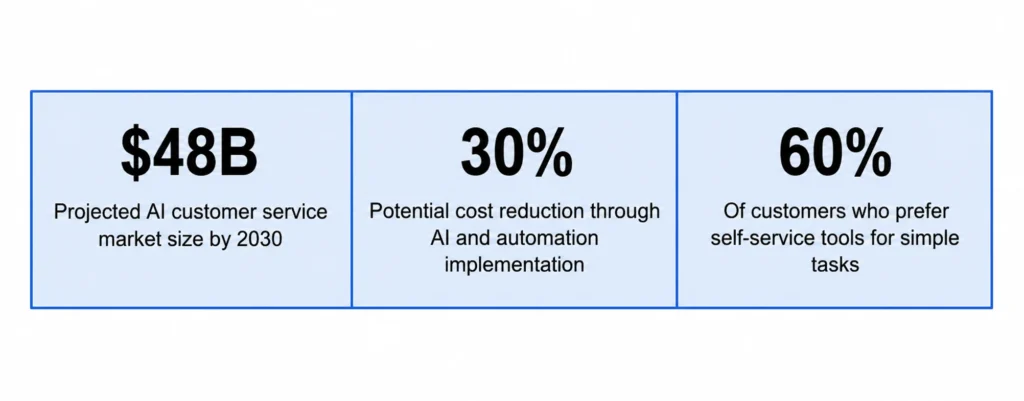
The AI customer service market is projected to reach nearly $48 billion by 2030. Businesses are investing in AI customer support software at scale because the alternative — scaling human headcount proportionally with ticket volume — is economically unsustainable for the majority of organizations.
AI can reduce customer service costs by 30% while simultaneously improving response times and coverage hours. Cost reduction alongside quality improvement is rare in any operational investment. It explains both the pace of AI adoption and why customer service AI solutions have moved from experimental to essential.
Does Your Business Need an AI Chatbot?
Before evaluating specific AI chatbot software for businesses, every operator should answer the following questions. If you answer yes to three or more, deploying an AI chatbot for customer support is not optional — it is overdue. This is the most practical checklist for assessing whether a chatbot for your customer service team will deliver measurable ROI.
| ☐ High ticket volume problems — Your team is regularly overwhelmed by volume and response times are slipping beyond your SLA commitments. |
| ☐ Repetitive query patterns — A significant share of your tickets — 30% or more — are variations of the same five to ten questions that could be automated. |
| ☐ Off-hours coverage gap — You cannot staff 24/7 human support but your customers operate across time zones and expect an instant customer support solution outside business hours. |
| ☐ Agent capacity constraints — Agents are spending time on Tier 1 queries that could be automated, leaving less capacity for complex, high-value interactions. |
| ☐ Self-service failure rate — More than 25% of customers who attempt self-service fail to find answers and convert into inbound tickets — feeding the high ticket volume problem. |
| ☐ Response time above target — Your average first response time consistently exceeds channel benchmarks due to queue volume — a signal that a faster customer support solution is urgently needed. |
| ☐ Scaling cost pressure — You need to scale customer support capacity but cannot scale headcount at the same rate — the exact scenario where a scalable customer support solution built on AI delivers the highest ROI. |
Conclusion: Customer Support Is Your Most Measurable Revenue Risk
Customer support failure is not a soft problem with soft consequences. It is a measurable, documented, financially quantifiable business risk — one that costs U.S. businesses $1.6 trillion annually and drives 85% of all customer churn.
The businesses that win on customer experience in the next five years will not be the ones that spent the most on marketing. They will be the ones that are invested in making every customer interaction — whether handled by a human or an AI, at 3pm or 3am, on chat or on phone — consistently fast, consistently accurate, and consistently personal.
That is not an aspiration. With the right customer support automation software deployed at scale, it is entirely achievable today.
Ready to Eliminate Every Challenge Analyzed in This Post?
ProgressArc AI chatbot software offers unified customer context, and the complete scalable customer support solution built for businesses that cannot afford to lose customers silently.
→ Visit progressarc.io to get started